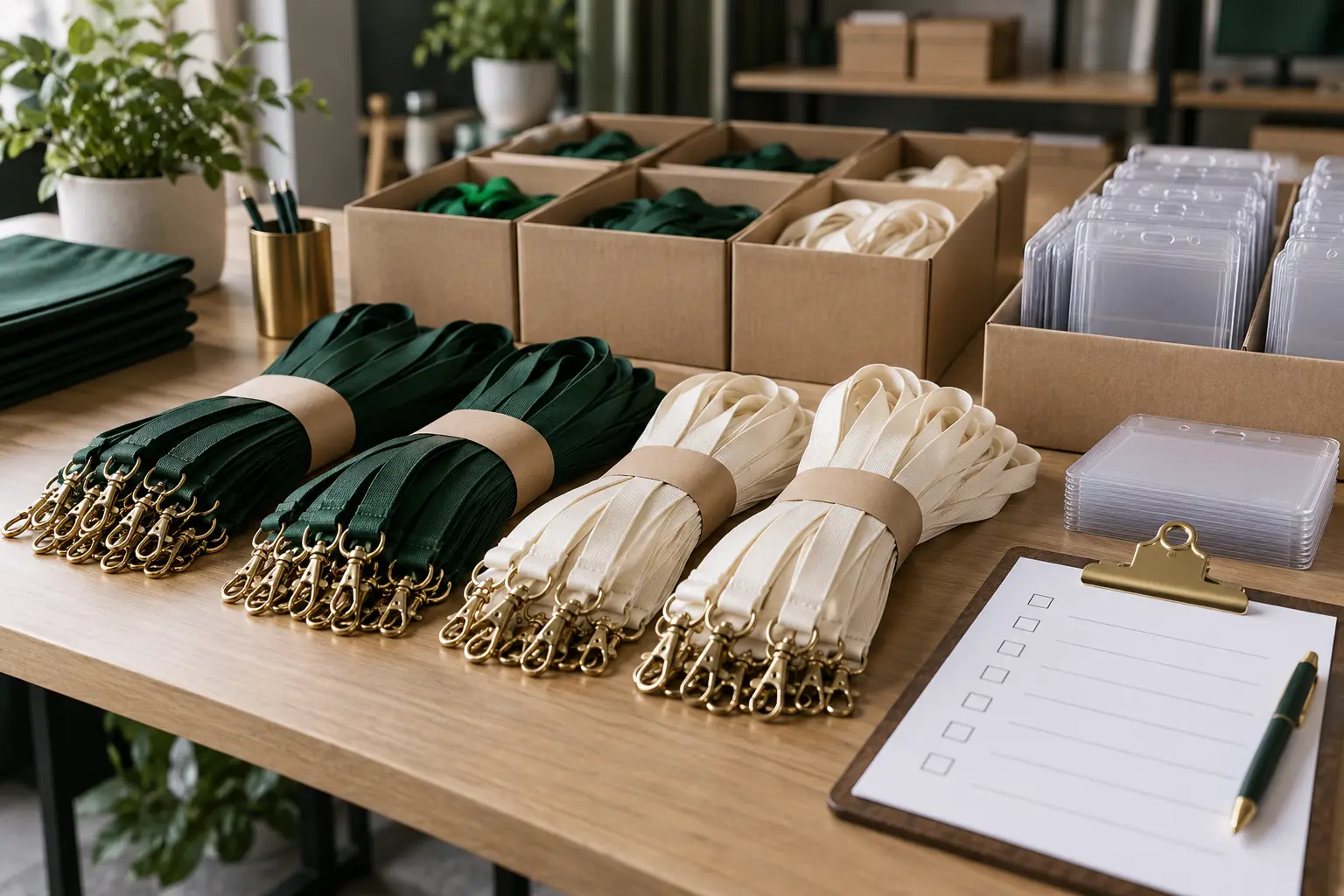
A 500-person conference is large enough for small specification errors to become registration problems, but still small enough that too many custom role designs can create unnecessary setup cost and leftover stock. A detailed Reddit discussion about preparing on-site name badges for roughly 500 attendees shows how printers, badge stock, holders, custom lanyards and software become one operating system. The lanyard order should be planned inside that system, not as a separate giveaway.
Build the quantity from people and operating roles
Do not send a supplier only the number “500.” Separate the registered attendee count from every person who will also need a credential.
- Registered attendees
- Speakers and moderators
- Organizer and venue staff
- Exhibitors and sponsors
- Production crew, media and vendors
- Walk-in registrations
- Lost or damaged replacements
- Demonstration and training sets for the registration desk
The correct spare quantity depends on registration policy, walk-in behavior, role changes and whether unused generic credentials can be used at a later event. Ask the event team for a count by function before choosing a buffer.
Respect quantity per design
LANYVO's custom-production minimum is 500 pieces per design. Five hundred total pieces divided among many strap artworks is not the same as one 500-piece design. This matters when a conference wants a separate lanyard for every role.
| Requirement | Practical route | Why it helps |
|---|---|---|
| One event brand for everyone | Use one custom strap and change the badge face by role. | Keeps the strap order concentrated in one design. |
| Small VIP or speaker group | Add a badge ribbon, colored insert or hospitality card. | Avoids a very small custom strap run. |
| Large exhibitor group | Consider a separate design only if the quantity and operational value justify it. | Protects role visibility without creating avoidable leftovers. |
| Sponsor exclusivity | Use one sponsor-approved strap across attendee roles. | Maintains contracted visibility and simplifies approval. |
Lock the badge system before confirming the clip
Provide the finished badge insert size, orientation and holder pocket size. For on-site printing, identify the badge stock, fold lines, slot or hole position and whether the badge enters a clear holder after printing.
A single swivel hook, bulldog clip or double clip changes how the badge sits. Test the final badge weight. A clip that performs well with a thin card may behave differently with a large holder, ribbons and an agenda card.
Decide between pre-assembly and on-site assembly
Pre-assembled kits
The lanyard and holder arrive connected, counted and packed for distribution. This can reduce repetitive work before the doors open. Confirm that the printed badge can still be inserted efficiently and that the holder orientation matches the registration workflow.
Separate components
Separate lanyards and holders give the registration team more flexibility when badges are printed on demand. They also create more loose components to count and stage. Ask for aligned bundles and clearly labeled inner cartons.
Plan packing from the registration desk backward
Specify bundle quantity, role labels, carton marks and whether the first-use cartons should contain the most common attendee kits. The person opening the carton should understand what is inside without sorting every lanyard.
If the venue has several check-in stations, divide the shipment accordingly. A master carton can contain station-ready inner packs with a packing list for reconciliation.
Protect the fixed event date
Work backward from the required arrival date, not the opening day. Allow time for receiving, counting, printer testing, badge insertion and moving the goods to the venue. Production and transport are separate parts of the schedule.
Artwork proofing and physical sampling are approval stages, not automatic promises of the same lead time for every project. Confirm the exact timeline after the supplier reviews artwork, material, hardware, packing and destination.
500-person conference RFQ checklist
- Quantity per strap design
- Role counts and intended role-identification method
- Event artwork and sponsor files
- Strap material, width and printing method
- Finished lanyard length
- Badge insert and holder dimensions
- Clip, breakaway and accessory requirements
- Pre-assembly or separate packing
- Bundle quantities and carton labels
- Destination, postal code and required arrival date
For price planning, compare the same specification at 500 and 1,000 pieces rather than comparing incomplete quotes. See our custom lanyard pricing guide and on-site badge printing guide.
Bottom line
For a 500-person conference, the most efficient order usually starts with one controlled strap specification, a clear badge system and packing that matches the registration process. The total headcount is only the beginning of the brief.
Frequently asked questions
How many lanyards are needed for a 500-person conference?
Start with the registration count, then add staff, speakers, exhibitors, vendors, walk-ins, replacements and any sponsor hospitality packs. Do not use a universal spare percentage without reviewing the event plan.
Can 500 pieces be split across several custom designs?
LANYVO's custom MOQ is 500 pieces per design. Small role groups can often share one strap design and use different badge artwork, ribbons or holder inserts.
Should badge holders be assembled before delivery?
Pre-assembly can reduce work at registration, but it must match the on-site printing workflow. Confirm whether inserts are printed in advance or produced at check-in before choosing the packing method.
This article was informed by current event-community discussions about practical planning problems. The manufacturing and specification recommendations are LANYVO's original guidance.
Reddit discussion 1: event-community context used for this guide