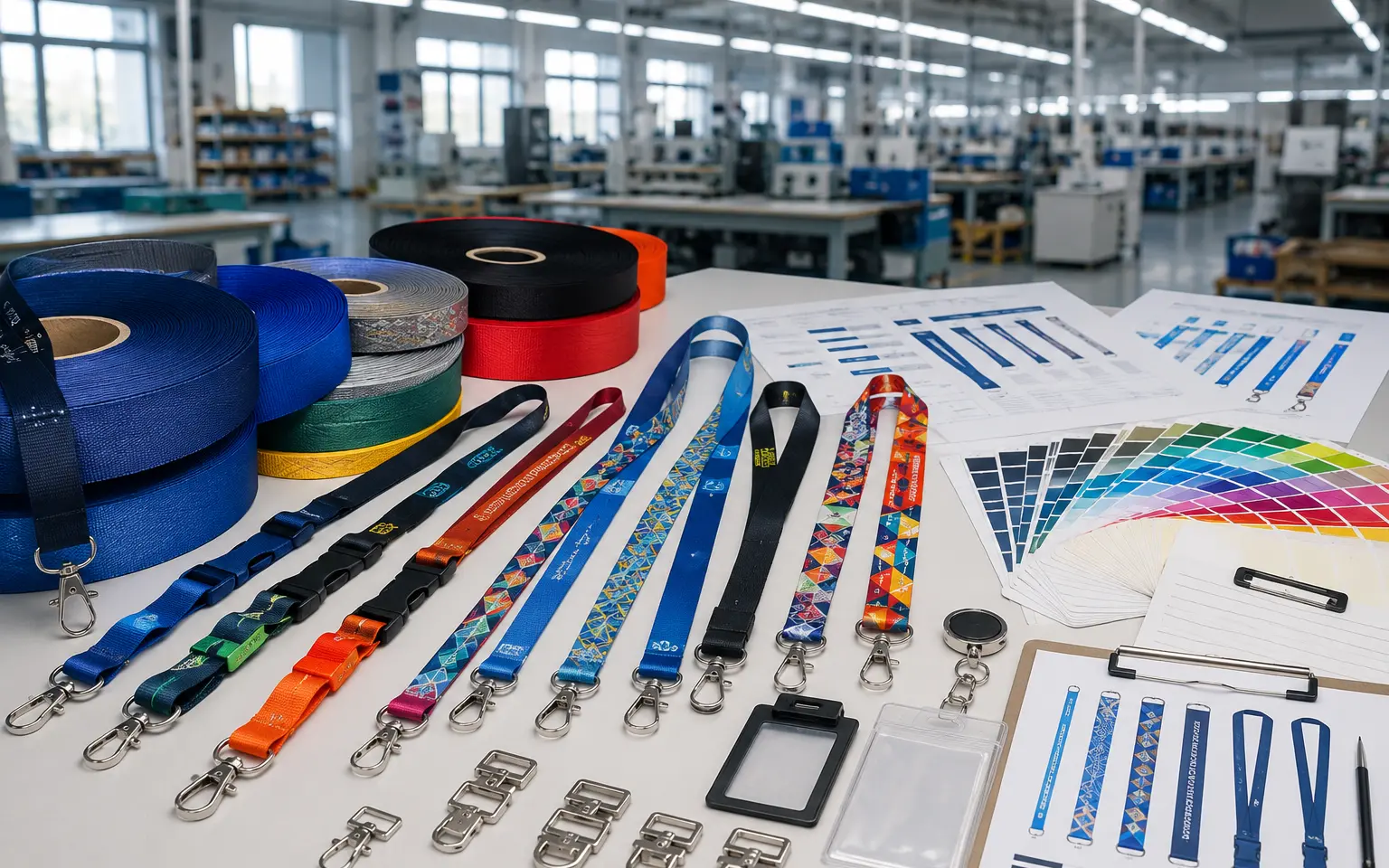
Manufacturer, reseller and retailer: what actually changes?
Buyers searching for a custom lanyard manufacturer in China, a bulk lanyard supplier or wholesale custom lanyards often see nearly identical product photographs. The commercial model behind those pages can be very different. A factory develops and produces to an approved specification. A reseller coordinates another producer and adds account service. A retailer normally sells a narrower ready-made or lightly customized assortment.
| Buying factor | Source manufacturer | Retailer / reseller | Question to ask |
|---|---|---|---|
| Best fit | Bulk custom programs and repeat orders | Ready stock, small orders or local service | Who controls the actual production specification? |
| Customization | Material, width, artwork method, hardware, holder and packing can be reviewed together | Often limited to a preset product or outsourced options | Can every quoted component be confirmed in writing? |
| Price structure | Setup is spread across the production quantity | May include another commercial margin and service layer | Does the quote include sample, packing and freight? |
| Quality control | Production checkpoints can follow the approved sample and specification | Depends on the reseller's supplier-control process | What is inspected before packing? |
| Repeatability | Specification records can support reorders | May change if the upstream source changes | How are color, hardware and artwork records retained? |
Why factory-direct unit economics can be more attractive
A lanyard is a low-cost product, but it still has setup work: artwork preparation, color alignment, printing or weaving setup, cutting, sewing, hardware assembly, inspection and packing. At factory scale, those steps are spread across the order quantity. That is why a properly specified bulk program can be more economical per piece than buying customized items through a retail chain.
This does not mean the lowest factory number is automatically the best deal. Thin webbing, a cheaper clip, inconsistent print registration or unsuitable packing can create replacement costs at the event. Compare landed value: the approved construction, usable quantity, packing, freight, duty exposure and delivery risk.
What LANYVO can customize as a source manufacturer
LANYVO reviews projects from Dongguan, Guangdong, China. The custom-production MOQ is 500 pcs per design. Depending on the artwork and use, a buyer can specify polyester, recycled RPET or woven webbing; common reference widths such as 10, 15, 20 and 25 mm; screen print, dye sublimation or jacquard woven branding; and compatible clips, hooks, rings, breakaway releases, detachable buckles or badge holders.
Customization should solve a real buying need. A conference may need role-color sorting and badge sleeves. A corporate ID program may prioritize breakaway safety and reorder consistency. A promotional distributor may need neutral bulk cartons or customer-ready individual packing. The specification—not a generic catalog photo—should control the quotation.
Information that produces a reliable factory quote
- Quantity for each design or role color
- Artwork file and required logo position
- Material, width and finished length
- Print, sublimation or woven preference
- Hook, buckle, breakaway and holder
- Bulk, grouped or individual packing
- Destination city, country and postal code
- Required arrival date, not only ship date
How to verify that the supplier can handle the order
Ask for project-relevant evidence
Request current photos, video, samples or documents related to the material and production route you are considering. A factory page is useful context, but your purchase decision should rely on the approved specification and project evidence.
Approve a sample route
Choose whether an electronic proof, a stock reference sample or a custom pre-production sample is required. A complex badge kit or woven construction deserves more validation than a simple repeat screen-print order.
Define quality checkpoints
Confirm what will be checked: strap dimensions, print position, color reference, stitch security, hardware operation, holder compatibility, quantity and carton marks. A vague promise of “good quality” is not an inspection plan.
Look for commercial red flags
Be cautious when a supplier gives a universal price without material or hardware details, promises an arrival date before knowing the destination, refuses to describe packing, or changes the specification after the order. Clear limitations are more trustworthy than impossible guarantees.
The buying decision
Choose a factory when the order is custom, repeatable and large enough to benefit from production-level control. Choose a reseller when local support, consolidated purchasing or a very small ready-stock order matters more. If you compare both routes, send the same RFQ and ask for the same delivered scope.
Frequently asked questions
Is a source factory always cheaper than a retail supplier?
No. A factory can offer better unit economics for repeatable bulk custom work because production and customization are managed closer to the source, but the correct comparison must include setup, sample, packing, freight, duty and service on the same delivery term.
What is LANYVO's minimum order quantity?
LANYVO's custom-production MOQ is 500 pcs per design. Different designs or role variants should be listed separately so setup and quantity can be reviewed correctly.
Can a factory customize more than the logo?
Yes. Subject to project review, customization can include material, width, length, print or weave method, colors, hooks, clips, safety breakaways, detachable buckles, badge holders and packing.
How should I verify a lanyard factory?
Ask for specification review, a sample route, current project-relevant production evidence, QC checkpoints, packing details and a quotation that clearly states what is included. Do not rely on a homepage claim alone.
Get a project-specific factory quotation
Send quantity per design, artwork, construction, badge-holder or hardware needs, packing, destination and required arrival date. LANYVO will review the exact specification rather than applying a generic retail price.