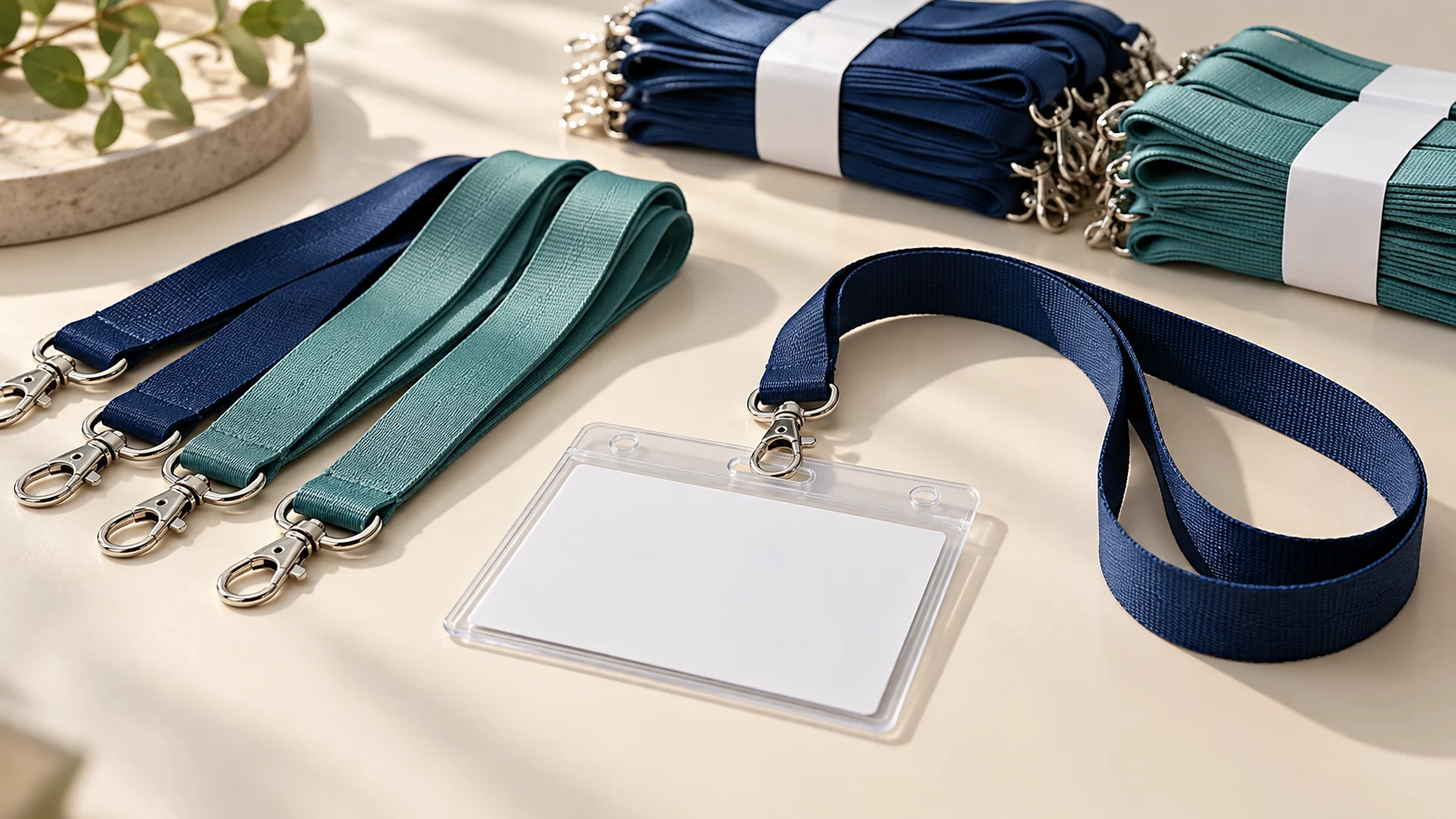
The holder is part of the product specification
Many event buyers request custom lanyards with badge holders but send only a logo and attendee count. A clear sleeve that is too small, a slot that does not match the clip or a portrait holder ordered for a landscape badge can make the whole kit unusable. Treat the credential, holder, attachment and strap as one system.
Buy together or source separately?
| Option | Advantages | Risks | Best fit |
|---|---|---|---|
| One factory supplies the complete kit | Fit can be checked; one packing plan; consolidated accountability | Buyer must approve every component and printing requirement | Conference, trade show, festival and access programs |
| Buy lanyards and holders separately | Use existing inventory or a local badge-printing partner | Clip/slot mismatch, duplicated freight and split responsibility | Organizations with a proven standard sleeve |
| Buyer supplies the holders | Preserves an approved local credential format | Factory needs physical dimensions or samples; inbound coordination adds time | Repeat corporate and institutional programs |
Compatibility details the manufacturer needs
- Finished insert width and height
- Portrait or landscape orientation
- Holder outer dimensions and material thickness
- Top-load, side-load or zip-closure format
- Center slot, double slot or punched hole
- Single hook, double hook or badge reel connection
- Breakaway and detachable buckle requirements
- Printed badge, blank insert or holder only
A double-hook lanyard can keep a wide credential facing forward, while a single swivel hook is simple and flexible. A badge reel adds reach for access control. A breakaway release may be required for schools, factories or operational settings. Each choice changes assembly and price.
What drives the kit price?
Quantity per design and role
LANYVO's custom-production MOQ is 500 pcs per design. If an event needs attendee, staff, sponsor, media and VIP versions, list the quantity of every version. Five colors are not automatically priced like one 2,500-piece design because artwork, setup, sorting and packing can differ.
Strap and logo construction
Polyester, RPET and woven webbing have different costs and visual results. Screen printing suits simpler solid artwork, sublimation supports detailed full-color graphics, and woven branding can create a textile appearance. Width, length and print coverage also change material and processing.
Hardware and safety
Hooks, rings, buckles, breakaways and reels vary by size, finish and construction. Select them from actual use and badge weight rather than the cheapest catalog thumbnail.
Holder and credential
Clear vinyl thickness, rigid plastic, custom size, closure type and printed insert all affect the quotation. If badges are printed locally, state whether holders should arrive empty, with blank inserts or preassembled in role packs.
Packing and sorting
Bulk-packed lanyards and nested holders can reduce space. Preassembled kits save registration labor but may increase packing volume. Individual bags protect and separate each kit but add materials and freight volume. Role-labeled bundles often provide the best balance for event teams.
Compare product price and landed cost
A source-factory quotation can be more economical than retail purchasing at bulk volume because customization, assembly and packing are coordinated at production. But compare the complete kit: usable holders, assembly, rejected or spare allowance, inner packing, cartons, freight, duty and local handling. A low unit number for an incompatible holder is not a saving.
Packing plans for event operations
Tell the supplier how the venue team will receive and distribute the kits. Options include separate cartons by role, counted inner bags, preassembled holder-and-lanyard sets, alphabetical badge insertion handled locally, or destination-specific carton marks for multiple venues.
Ask for pieces per bag, bags per carton, carton dimensions and gross weight. Those data support freight comparison and help the receiving team plan storage and registration-desk replenishment.
A fixed-deadline kit inquiry: what must be ready before sampling?
A recent buyer inquiry asked us to review a large quantity of custom event lanyards and clear badge holders, with several separately labelled allocation groups and one final delivery address. The request was detailed enough for an initial specification review, but the final print artwork and allocation sheet had not yet arrived. This was an inquiry, not a confirmed production or delivery commitment. It illustrates why a complete specification can still leave the approval schedule unresolved.
For bulk lanyards with badge holders on a fixed event deadline, we would confirm the following four items in parallel before stating whether a physical sample, production and air transport can fit the date.
1. Send production-ready vector artwork with the first RFQ
For a repeating strap design, a reference photo or an email description can support a preliminary discussion, but it cannot settle the printing layout. Send an editable AI file or a genuinely vector PDF, with fonts outlined or supplied and linked graphics embedded. A PDF containing only a low-resolution photo is still raster artwork. Include the finished strap width and length measurement, repeat spacing and direction, color references, print area, hook position and any elements that must remain readable when the strap is worn.
Ask the supplier to price the most economical method that reproduces the approved design, then show double-sided sublimation as a separate option if it costs more. A simple solid-color design may suit a different method from a detailed full-color repeat; the artwork, color tolerance and viewing side determine the choice. Make front-only versus both-side visibility explicit in the proof. A digital layout can move quickly once the file is complete; physical sampling still needs an agreed approval path.
2. Specify the badge holder by usable insert size
“Fits a 100 × 70 mm card” must refer to the usable internal space, not merely the holder’s outside dimensions. Treat that figure as an example to verify against the actual finished insert, including its thickness and orientation. Request the exact internal opening and outer measurements, material and softness, loading direction, slot geometry and product photos. If a soft sleeve is preferred, do not substitute a rigid holder without checking the same usable insert fit.
Before approving the kit, test one real insert in one proposed holder and clip the holder to the selected lanyard. Check that the card slides in, remains visible, hangs in the intended orientation and can be removed as the event team expects. Use our badge-holder measurement template to record the result.
3. Give the factory the allocation table before packing is priced
When the goods go to one address but must arrive in multiple unequal groups, the factory needs a spreadsheet listing group label, set quantity, kit version, cartons or inner bags and any spare allowance. The group totals must reconcile with the order total. “Pack by location” alone does not tell the team whether holders and lanyards should be preassembled, counted separately or bagged together.
Agree on a visible label format and a carton-level packing list before bulk packing. Ask whether each group may span several cartons and how mixed or partial cartons will be marked. This work changes labor, carton count, chargeable air-freight volume and the time needed for a final count check. One delivery address simplifies transport, but it does not remove the sorting step.
4. Work backward from the required arrival date
Build a schedule with dates for final files and group quantities, proof approval, any physical sample and courier transit, bulk production, kit-fit checks, sorted packing, air dispatch, customs and receipt at the final address. State both the preferred arrival date and the latest usable date. If the customer must inspect or redistribute the kits after arrival, leave that time outside the supplier’s transit estimate.
A supplier can discuss conditional options before the files are ready, but should not promise an arrival date based on an unapproved design. Ask for a written latest artwork-approval cutoff, the sample decision and the first point at which the production slot is confirmed. Air freight is quoted separately from manufacturing; compare the named Incoterm, destination charges and what is included before comparing totals. See our sample-to-delivery timeline for the stages that need a buffer.
What this inquiry teaches: the earliest useful action is to share the final artwork and the actual badge insert while the supplier reviews holder fit and the grouped packing plan. That enables a defensible quote and schedule. It does not guarantee that every urgent deadline can be met.
Build a lanyard and badge-holder compatibility brief
Enter the finished badge insert and select the carrying and packing setup. The result creates an RFQ brief; the physical holder and clip still require sample confirmation.
Physical checks before production
Dimensions describe the finished insert, not automatically the holder's outer size. Final clearance, slot geometry, clip movement, badge thickness and packing must be verified with the proposed components.
RFQ information for an accurate quote
- Total quantity and quantity per role/design
- Lanyard material, width, length and artwork
- Logo method and color references
- Badge insert and holder dimensions
- Hook, breakaway, buckle or reel selection
- Assembly and role-sorting requirement
- Destination city/country/postal code
- Required arrival date and event date
Why source-factory coordination matters
When the factory reviews the strap, attachment, holder and packing together, incompatibility can be caught before bulk assembly. It also creates one approved specification for future conference or corporate reorders. That control—not simply a “factory price” label—is the most valuable difference from buying unrelated retail components.
Frequently asked questions
Should I buy lanyards and badge holders together?
Buying together can simplify compatibility, packing and one-supplier accountability. Buying separately can make sense if you already hold approved sleeves or have a local print-and-insert workflow. Test the physical combination either way.
What badge dimensions should I send?
Send the finished insert width and height, portrait or landscape orientation, holder outer size if known, slot position and whether the badge is paper, PVC or another thickness.
What affects the price of a lanyard badge-holder kit?
Quantity per design, webbing material and width, logo method, hooks, breakaway or detachable parts, holder size and thickness, printing, role sorting, individual packing and freight all affect cost.
What is the MOQ for a custom badge-holder lanyard kit?
LANYVO's custom-production MOQ is 500 pcs per design. Holder availability, customization and role splits are reviewed with the exact project.
Get a project-specific factory quotation
Send quantity per design, artwork, construction, badge-holder or hardware needs, packing, destination and required arrival date. LANYVO will review the exact specification rather than applying a generic retail price.