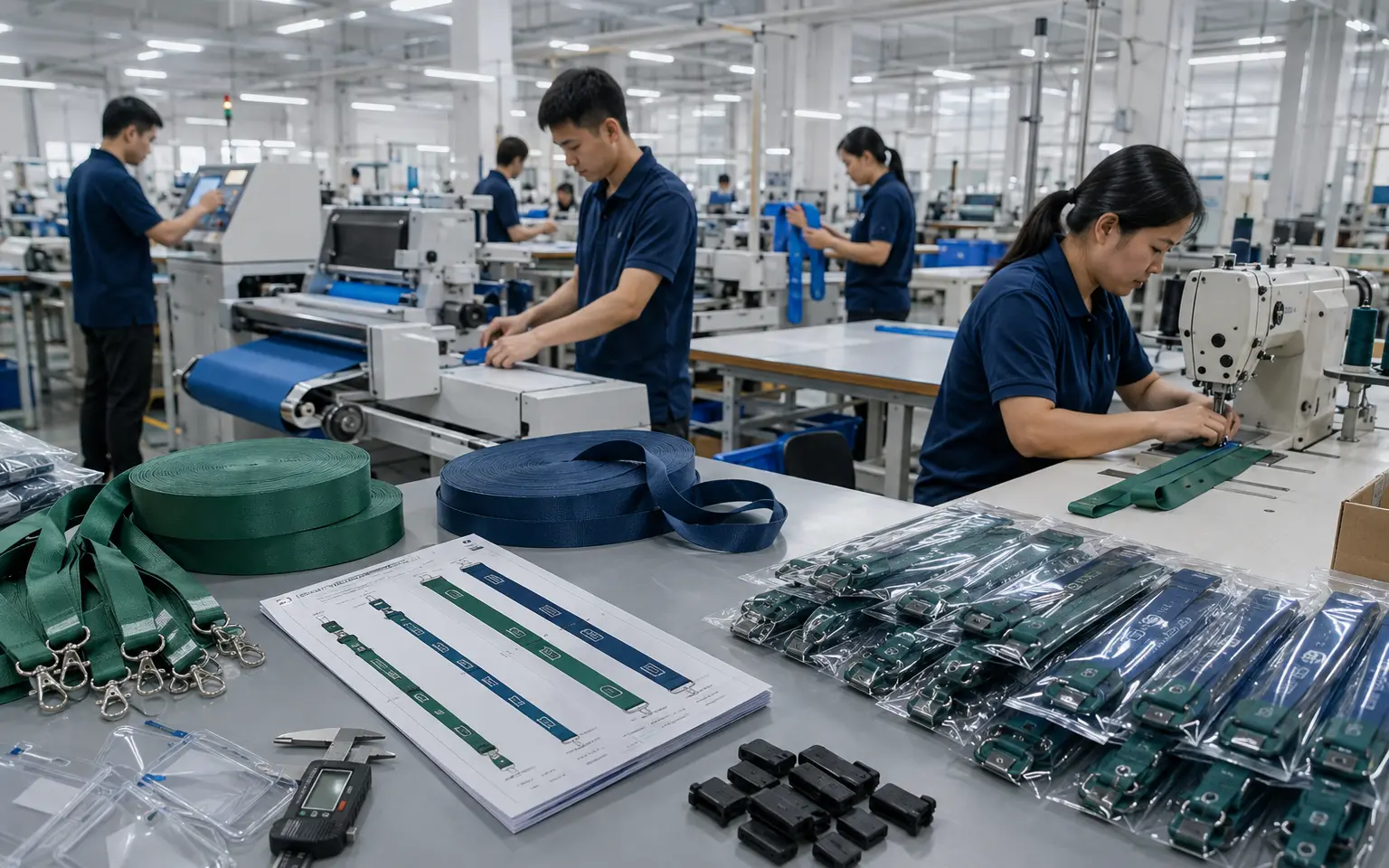
Buyer-question focus: B2B buyers comparing overseas suppliers consistently look beyond price to MOQ, samples, communication, customization and shipping. The practical question is not “factory or reseller?” but “which production controls change my usable delivered cost?”
What factory-direct should mean
A genuine custom lanyard manufacturer in China should be able to explain how artwork becomes an approved strap, how components are selected, where quality is checked, how goods are packed and what triggers the production schedule. “Factory direct” is not proven by a price banner or stock photograph.
LANYVO coordinates custom lanyard specification, sampling, production, quality control and export support from Dongguan, Guangdong, China. The custom-production MOQ is 500 pcs per design.
Eight cost-control advantages
| Control point | How it can reduce cost | What the buyer must approve |
|---|---|---|
| 1. Process selection | Avoid paying for a complex method that the artwork does not need | Screen print, sublimation or woven result |
| 2. Setup planning | Spread artwork and production setup across a useful quantity per design | Final design count and quantity split |
| 3. Standard components | Use suitable stocked hooks, buckles and holders instead of unnecessary custom hardware | Function, finish and compatibility |
| 4. Kit integration | Combine strap, holder and assembly in one production plan | Badge size, clip, assembly and role sorting |
| 5. Packing design | Balance registration labor, product protection and carton volume | Bulk, grouped, preassembled or individual packing |
| 6. In-process QC | Catch print, sewing or hardware problems before the full order is packed | Reference sample and inspection criteria |
| 7. Reorder records | Reduce redevelopment and inconsistent substitutions on repeat programs | Approved specification version |
| 8. Carton data | Improve freight comparison using real packed weight and dimensions | Route, Incoterm and delivery scope |
1. Match the logo method to the artwork
Simple solid marks may suit screen printing. Full-color gradients and detailed sponsor graphics often suit dye sublimation. A woven construction can create a premium textile appearance but may require artwork simplification. A factory should recommend from the artwork and use—not automatically quote the highest or lowest process.
2. Control design count before chasing volume discounts
Setup is connected to each design. One 2,000-piece event lanyard can have a different cost structure from four 500-piece role versions. Before splitting colors, ask whether staff, VIP and speaker groups can share one strap and use different badges. This protects customization while keeping production quantities useful.
3. Standardize hardware where function allows
Swivel hooks, bulldog clips, rings, breakaways, detachable buckles and reels serve different tasks. A standard compatible part may be more economical and easier to repeat than a special finish or mold. Do not remove a safety or access-control feature merely to reduce price; simplify parts that do not add buyer value.
4. Integrate the lanyard and badge-holder kit
A lanyard and badge holder manufacturer can review the holder slot, clip, orientation and assembly together. That can prevent the hidden cost of receiving 1,000 straps that twist a landscape badge or do not fit a selected sleeve. Preassembly may save venue labor, while separate nested packing may reduce freight volume.
5. Design packing from the receiving workflow
Retail-style individual bags are not automatically better. Bulk bundles use less material and volume; role-labeled packs help registration; individual packs protect presentation or support distribution. Ask for pieces per inner pack, pieces per carton, carton dimensions and gross weight before selecting the format.
6. Define quality before production
An approved sample and written checkpoints reduce rework risk. Confirm strap width and length, print position, color reference, stitching, hook movement, breakaway operation, holder fit, quantity and carton marks. The cheapest unit price is expensive when part of the order cannot be used at the event.
7. Preserve specifications for repeat orders
Record the artwork version, material, width, color, method, hardware reference, sewing, holder, packing and approval sample. Repeat programs can then start from controlled data instead of a screenshot. This is especially important for distributors and annual conferences where the upstream source should not change silently.
8. Use real carton data to choose shipping
Lanyards are light, but badge holders and individual packaging add volume. Courier and air freight may use volumetric weight. Sea freight has different origin, destination and final-mile costs. A factory quotation becomes more useful when the packed order, destination postal code, required arrival date and trade term are stated clearly.
Where retail or reseller buying can still make sense
A local retailer can be convenient for ready stock, very small quantities, local credit terms or one consolidated promotional order. A source factory is strongest when the order is custom, repeatable and large enough to benefit from production-level control. Do not force factory sourcing onto a requirement that does not match the MOQ or schedule.
Verify the supplier before comparing price
- Ask who controls production and the written specification
- Request project-relevant factory or process evidence
- Confirm electronic proof, stock sample or custom sample route
- Ask what is inspected and recorded
- Review badge-holder and hardware compatibility
- Get packing and carton data
- Compare the same Incoterm and delivery scope
- Require a schedule tied to final approval
Send one normalized RFQ to every supplier
Provide quantity per design, artwork, material, width, length, logo method, hardware, badge holder, packing, destination and required arrival date. Ask every supplier to separate product, setup, sample, packing and freight where possible. That makes the quotation auditable and shows whether an apparent saving comes from efficiency or from a different specification.
Review LANYVO's factory and production evidence, then send the exact project inputs for a factory-specific quotation.
Frequently asked questions
Are factory-direct custom lanyards always cheaper?
No. A source manufacturer can improve bulk economics by controlling production, customization, assembly and packing, but buyers must compare the same specification, quantity, trade term, freight scope and quality requirement. Small ready-stock orders may still suit a retailer.
What should a factory quotation include?
It should identify quantity per design, material, width, length, logo method, colors, hardware, holder, sample route, packing, price basis, trade term, production assumptions and delivery scope.
How can buyers verify a source lanyard factory?
Ask for project-relevant production evidence, an explainable sample route, written QC checkpoints, component compatibility review, packing data and clear limitations. A low price or homepage label alone is not verification.
What is LANYVO's MOQ for custom lanyards?
LANYVO's custom-production MOQ is 500 pcs per design. Multiple role colors or logo variations should be listed separately so setup, sampling and packing can be reviewed accurately.
Get a project-specific factory quotation
Send quantity per design, artwork, construction, badge-holder or hardware needs, packing, destination and required arrival date. LANYVO will review the exact specification rather than applying a generic retail price.