
Lanyards keep ID badges, access cards, keys and event passes visible and within reach. Businesses also use them for visitor programs, sponsor branding and promotional gifts. Choose the attachment for the item being carried, then match the strap, artwork and packing to the application.
“We need lanyards” can mean a daily employee ID, a one-day visitor pass or a packaged gift. Those orders need different products. This guide connects 15 practical lanyard uses with the item carried, an appropriate configuration and the detail a bulk buyer should confirm.
Lanyard uses at a glance: match the application to the assembly
| Application | What it carries | Useful configuration to evaluate | Confirm first |
|---|---|---|---|
| Employee / member ID | Card in a holder | 15–20 mm strap; hook or reel | Reader reach and wearing policy |
| Visitors / contractors | Temporary pass | Visible role color; reusable holder | Issuing, expiry and return procedure |
| Conferences / exhibitions | Attendee badge | Full-color strap; holder matched to insert | Readable name, slot fit and delivery date |
| Backstage / volunteers | Role credential | Color plus printed role; suitable clip layout | Readable credential and actual access checks |
| Giveaways / retail | Keys or optional accessories | Branded strap; specified packaging | Recipient use and exact contents |
| Phone / awards | Phone or medal | Purpose-built phone tether or medal ribbon | Connection compatibility; not a generic ID hook |
Widths above are starting points for flat ID straps, not universal requirements. Use the lanyard width and length guide to check artwork and finished badge position.
1–5. Lanyard uses for workplaces, campuses and membership programs
1. Employee ID badges
A staff lanyard displays the employee badge without relying on a shirt pocket. For repeated scanning, compare a simple hook with a badge reel and check the finished reach to the actual reader. A daily-wear program should review edges, seams, holder condition and replaceable components. The badge holder must fit the card without covering essential information.
2. Visitor identification
A contrasting visitor strap helps reception staff distinguish issued passes. Use a clear holder and a documented return process if the kit will be reused. Keep personal information on the replaceable credential rather than on the reusable strap. A visitor-colored lanyard is a visual cue; authorization still depends on the site's check-in and access-control procedure.
3. Contractor and site-induction passes
Contractors may need an easily inspected pass showing a valid visit or induction period. Ask the site to define wearing, snag and release requirements before choosing hardware. A breakaway clasp needs the buyer's required construction and acceptance checks; it is not a guarantee of suitability for every task. Some work areas may prohibit neck-worn items.
4. University and school staff IDs
Campus staff can use lanyards for ID cards, library access or administration keys. Confirm the institution's policy, intended wearer group and card dimensions. Do not transfer an adult neck length to children without a separate fit and safety decision. Department colors can support sorting, while the card itself carries the actual identity and permissions.
5. Club, gym and association membership cards
A member kit can combine a recognizable strap with a replaceable membership card. If it is handed out in a welcome pack, specify whether the card is inserted and whether kits are grouped by membership tier. Plan how expired cards will be replaced. Neck straps may be unsuitable during some exercise or equipment use; follow the venue's rules.

6–10. Lanyard uses for conferences, exhibitions and event teams
6. Conference attendee badges
A conference lanyard displays a name badge for introductions and check-in. Work from the printed insert dimensions, then confirm holder orientation and the position of scanning codes. A full-color strap can accommodate the event identity and sponsor artwork. Approve a complete sample at wearing height; a clear design on a desk may be hard to read on the body.
7. Trade show exhibitor staff
Exhibitors can use coordinated lanyards to make booth staff easier to identify. Keep the logo repeat readable and check whether the organizer supplies its own mandatory badge. The purchaser may need the strap only, rather than a replacement credential kit. Confirm how spare straps are packed so the stand team can issue replacements without opening every carton.
8. Sponsor branding
A sponsored lanyard offers repeated visibility around a venue. The key buying detail is artwork approval: identify the lead sponsor, permitted logo versions, color expectations and repeat order. Check both sides of the worn strap and the section behind the neck. Obtain permission to use the artwork; adding more logos does not help if each becomes too small to read.
9. Backstage, press and production credentials
A crew pass may need to remain stable and legible during repeated inspections. Compare single-clip and double-clip layouts against the actual holder slots. Put the role in readable text as well as color, and keep credentials current. A lanyard does not prevent unauthorized access or credential copying; the organizer still needs its own validation process.
10. Volunteers and event service teams
Volunteer lanyards can distinguish information desks, registration and support teams. For bulk ordering, list the quantity per role instead of providing only a total. Request separate bundles with matching carton labels if that service is needed, and have the supplier confirm the packing cost. Avoid promising a dispatch date until artwork, quantities and packing are agreed.
For an event-specific configuration, compare custom trade show lanyards with badge holder and lanyard kits. These commercial pages cover the next purchasing step.
11–15. Lanyard uses for promotional distributors and brand programs
11. Promotional giveaways
A branded lanyard can be useful after an event if the recipient has a real item to carry. Decide whether the campaign needs a simple strap, a keyring or a holder kit. For a short, solid-color logo, compare screen printing; for gradients or a detailed repeat, evaluate sublimation. The quote should state exactly what the giveaway includes.
12. Retail merchandise and souvenirs
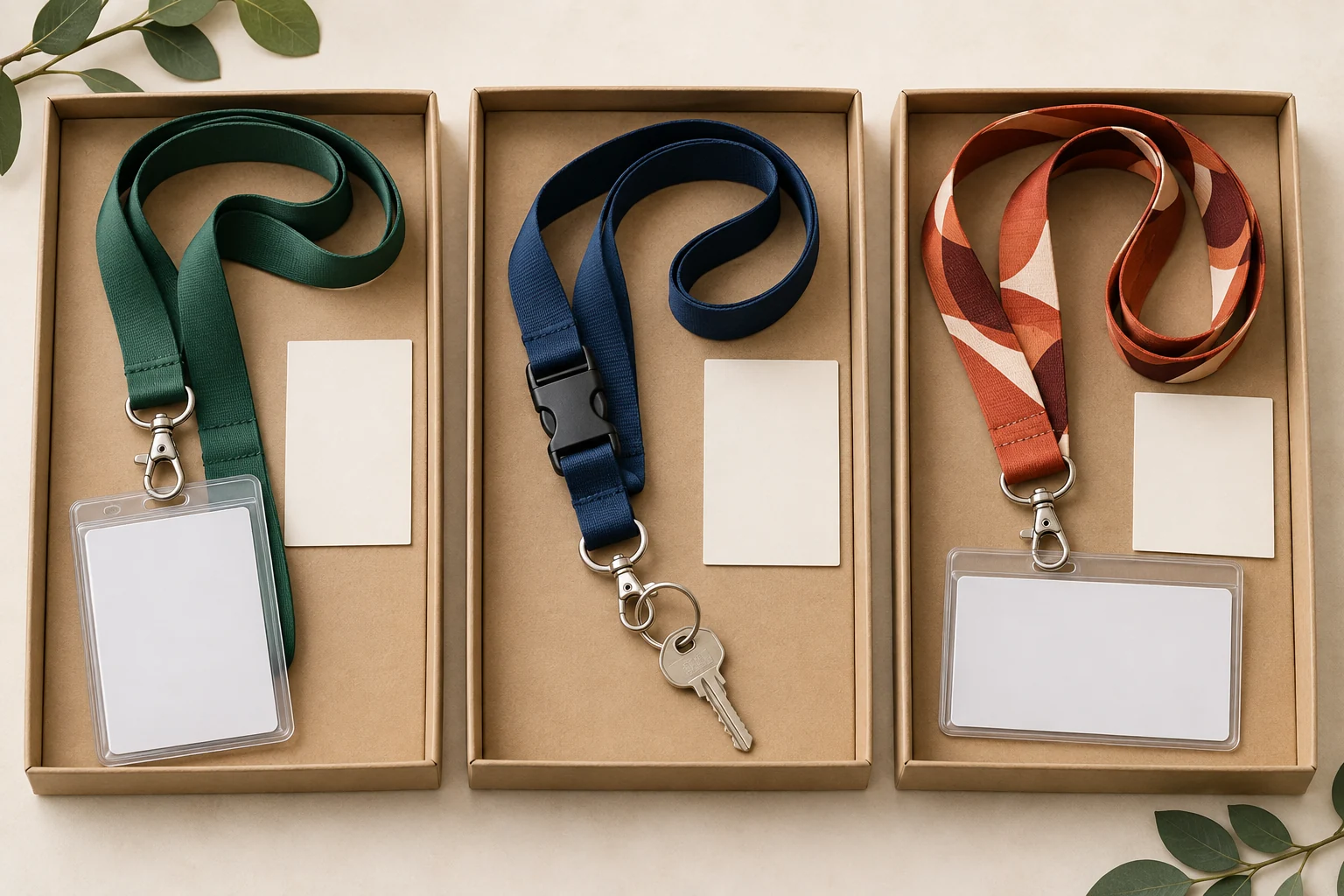
A shop may sell a lanyard as a patterned accessory or an event souvenir. Presentation matters: approve the pattern repeat, seam, clip finish and retail packing together. Ask whether a card, sleeve, barcode label or individual bag is included and price it separately when comparing suppliers. Do not assume the editorial packaging shown below is the standard supplied packaging.
13. Keys and access fobs
A key lanyard needs a compatible keyring or detachable section. Frequent users may prefer to remove the lower section without taking off the full strap. Check the actual load, key movement and access point, rather than attaching a heavy bunch simply because the ring has space. If neck wear is unsuitable, assess a purpose-made wrist key strap instead.
14. Phone-carry promotions
A phone campaign needs a dedicated tether or case connection, suitable hardware and an agreed load check. An ordinary badge clip is not enough to establish phone compatibility. Specify the phone-case opening, charging-port access, wearing method and intended device before quoting. Review the phone crossbody lanyard options as a separate product configuration.
15. Award and finisher medal ribbons
A medal ribbon is a related neck-worn product with its own connection and artwork layout. Specify the medal slot or ring, ribbon width, front/back orientation and whether assembly is required. Do not substitute an ID lanyard and hook without checking the medal design. The custom medal ribbon page covers this product rather than treating it as a standard badge accessory.
Things to put on a lanyard: choose the connection first
Besides keys, a lanyard can carry an ID card, access fob, event pass, membership card, small USB drive or whistle when the item and attachment are compatible. Phones need a dedicated tether. A badge reel changes reach; a detachable buckle changes how the lower section is removed; a rear breakaway changes how the neck loop releases. These parts do different jobs.
Match the hook opening to the holder slot, use a suitable keyring for keys, and test the final load and use. An identification lanyard is not a fall-arrest or equipment-restraint product. For detailed connector selection, continue to the lanyard attachment guide.
Ways to wear a lanyard
A neck loop suits visible IDs where the setting permits it. A purpose-made wrist strap can suit keys or a compatible small accessory. A detachable lower section or reel helps with frequent scanning. Clipping something to a bag changes the function from visible identification to carrying; check whether that still meets the program's purpose. Do not improvise a wrist fit by wrapping a long neck strap around the wrist.
How distributors can specify three useful kit formats
| RFQ format | Define the included items | Typical buying decision |
|---|---|---|
| Strap only | Webbing, logo, hook and any release component | Does the customer already have compatible badges or holders? |
| Credential kit | Strap, holder, optional card and agreed assembly | Are internal holder dimensions, insert orientation and role packing confirmed? |
| Key / access kit | Strap, keyring, optional detachable lower section or reel | Does the attachment suit the actual fob, reach and wearing policy? |
For comparable quotes, send the same specification at each quantity tier. State the quantity per design and color, strap width and measurement method, artwork, carried item, connection, packaging, destination and required arrival date. Request neutral packing or role-separated bundles explicitly; availability and pricing must be confirmed.
LANYVO's current published order policy distinguishes eligible standard-style trials from 100 pcs and custom-production quantity pricing from 500 pcs per design; screen printing and complex processes start at 500 pcs per design. Check the trial and MOQ policy for the route that applies to your specification. Do not assume every custom configuration qualifies for a 100-piece trial.
Frequently asked questions about lanyard uses
What is a lanyard used for in business?
It displays or carries an ID badge, access card, key or event credential. Businesses also use custom straps for visitor identification, sponsor branding and promotional programs.
What can you put on a lanyard besides keys?
An ID badge, access fob, membership card, event pass, compatible USB drive or whistle. Phones require a purpose-built tether and a compatibility check rather than a standard ID clip.
Are badge holders included with custom lanyards?
Only if the quotation includes them. Specify strap only or a complete kit, holder internal size, orientation, optional card insertion and packaging before comparing prices.
Does a breakaway clasp replace a detachable buckle?
No. A breakaway is designed to release the neck loop under force, subject to its specification. A detachable buckle is opened intentionally to remove the lower section. Specify each function separately.
Which lanyard is best for promotional distributors?
There is no single best style. Match the customer's application, artwork, quantity and carried item, then compare a defined strap-only or complete-kit quotation and approve the final sample.