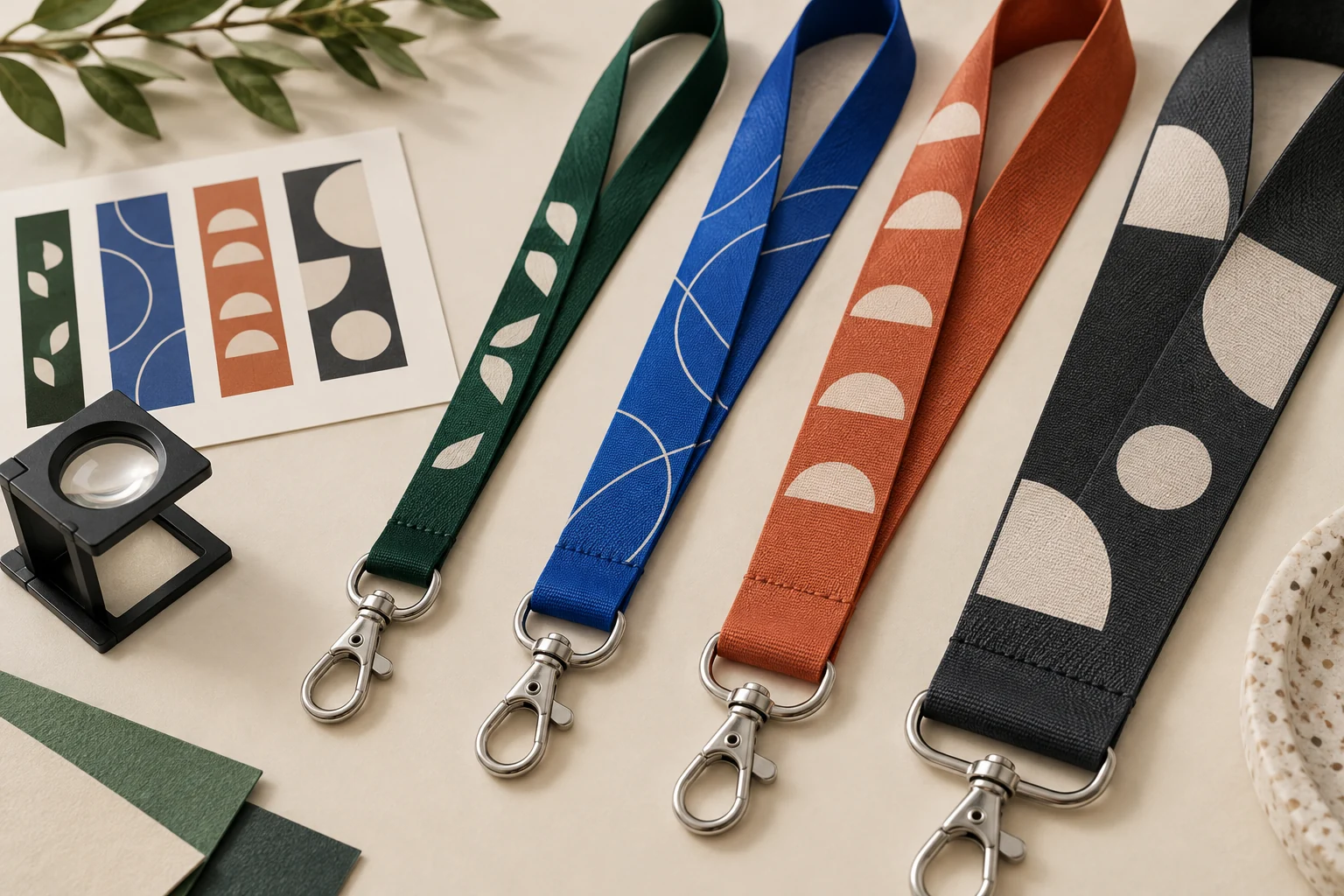
The most common adult neck lanyard reference is approximately 900 mm (35.4–36 in) in total flat length. Common widths are 10, 12, 15, 20 and 25 mm, with 20 mm often used for trade shows and general branding. Always confirm whether the supplier is measuring total flat length, loop circumference or finished drop.
Print or save the common widths, neck-length references and measurement-method checklist for an RFQ or sample approval record.
Need the quick chart or a custom order specification?
If you only need a printable table, open the lanyard size chart in mm and inches. This detailed guide explains how width, total flat strap length, hanging drop, logo placement and card-holder size interact. The often-cited 900 mm (about 35.4 inches) adult reference must be checked against the supplier's measuring method and your finished badge placement.
For trade show lanyards, buyers commonly compare 15, 20 and 25 mm widths depending on artwork and credential weight. Woven-logo details or breakaway attachments can affect construction; review the woven option and breakaway option before ordering by a size chart alone.
How to choose lanyard size by event or ID use
The activity name does not create one mandatory size. Use the application to identify the wearer, artwork, credential and release requirements, then approve the complete sample.
| Application | Width starting point | Length decision | Confirm first |
|---|---|---|---|
| Trade show / expo | 15–20 mm; 25 mm for higher-impact artwork | About 900 mm total flat is a common adult reference | Sponsor logos, badge orientation and holder slot spacing |
| Conference | 15–20 mm | Check the adult reference against the final badge position | Wearing time, name readability and registration packing |
| School / university | 15 mm is a common starting width | Use wearer-group fit checks; do not apply one adult standard to children | Institution policy, release requirement and card size |
| Corporate staff ID | 15–20 mm | 850–900 mm is an adult planning range, not a fixed rule | Card-reader height, badge reel and daily-wear policy |
| Festival / sports staff | 20 mm; wider for large passes or sponsor artwork | Check movement, pass weight and final scanning height | Role colors, large holder stability and group packing |
Choose the event, wearer, credential and artwork to create a starting specification and prefill the factory RFQ.
Common lanyard width specifications
| Metric width | Approx. inch width | Typical use | Artwork guidance |
|---|---|---|---|
| 6 mm | 1/4 in | Thin cords, phone straps and lightweight accessories | Use very simple text or no repeated logo |
| 10 mm | 3/8 in | Keys, simple staff IDs and low-profile programs | Short text and compact logos |
| 12 mm | 1/2 in | School IDs, lightweight events and tubular styles | Simple one-line branding |
| 15 mm | 5/8 in | Schools, conferences and general ID use | Good for repeated logos and short text |
| 20 mm | 3/4 in | Trade shows, corporate events and promotional programs | Balanced logo visibility and comfort |
| 25 mm | 1 in | VIP passes, merchandise and high-visibility branding | More space for detailed or full-color artwork |
| 30 mm | 1 3/16 in | Oversized branding, fashion merchandise and special programs | Confirm weight, fold, hardware and comfort |
Common neck lanyard length specifications
| Total flat length | Approx. inches | Typical fit / use | Buyer note |
|---|---|---|---|
| 700 mm | 27.6 in | Short custom fit after wearer testing | Do not use as a universal child standard; follow the institution's policy |
| 750 mm | 29.5 in | Short custom fit after wearer testing | Confirm badge height, release requirement and fit with the actual wearer group |
| 800 mm | 31.5 in | Short adult fit, staff IDs worn high on the chest | Useful when badges must stay clearly visible |
| 850 mm | 33.5 in | Common short-to-standard adult length | Often suitable for business and school IDs |
| 900 mm | 35.4–36 in | Most common adult reference length | Balanced for conferences, staff and trade shows |
| 950 mm | 37.4 in | Longer adult fit or lower badge position | Check scanning and access-control height |
| 1,000 mm | 39.4 in | Tall wearers, loose fit or special event styling | May swing more during movement |
| 1,050 mm | 41.3 in | Extra-long custom applications | Confirm total weight with badge holder |
| 1,100 mm | 43.3 in | Oversized or specialized programs | Usually custom rather than standard |
Children and school programs need a separate fit decision
There is no single child lanyard length that is automatically suitable for every age, height or school environment. Follow the institution's policy, confirm any breakaway requirement, and test the real badge position with the intended wearer group before approval. See the school lanyard size and safety checklist.
Common wrist lanyard lengths
| Finished strap reference | Approx. inches | Typical use |
|---|---|---|
| 150 mm | 5.9 in | Compact keys, USB drives and small accessories |
| 180 mm | 7.1 in | Common wristlet and key-lanyard reference |
| 200 mm | 7.9 in | Roomier wrist fit and phone accessories |
| 220–250 mm | 8.7–9.8 in | Long wrist straps or special attachment layouts |
Three length measurements that buyers often confuse
- Total flat length: the strap measured end to end before it forms a loop, usually excluding the hook.
- Finished drop: the vertical distance from the neck fold to the attachment or badge.
- Loop circumference: the complete loop measurement around the neck opening.
Write the required measurement method directly on the RFQ and drawing. A 900 mm total flat length does not mean a 900 mm finished drop.
How to choose width by artwork
Use 10–12 mm for simple text, 15 mm for compact repeating logos, 20 mm for most corporate and event artwork, and 25–30 mm when the design needs strong visibility, gradients or merchandise-style presentation.
Narrow vs wide lanyards: 10 mm, 15 mm, 20 mm or 25 mm?
Start with the smallest element that must remain readable, then check the complete badge assembly. A narrow strap can suit a short name or simple symbol; a wider strap gives artwork more room. Width alone does not establish the strength of the stitching, hook or safety release.
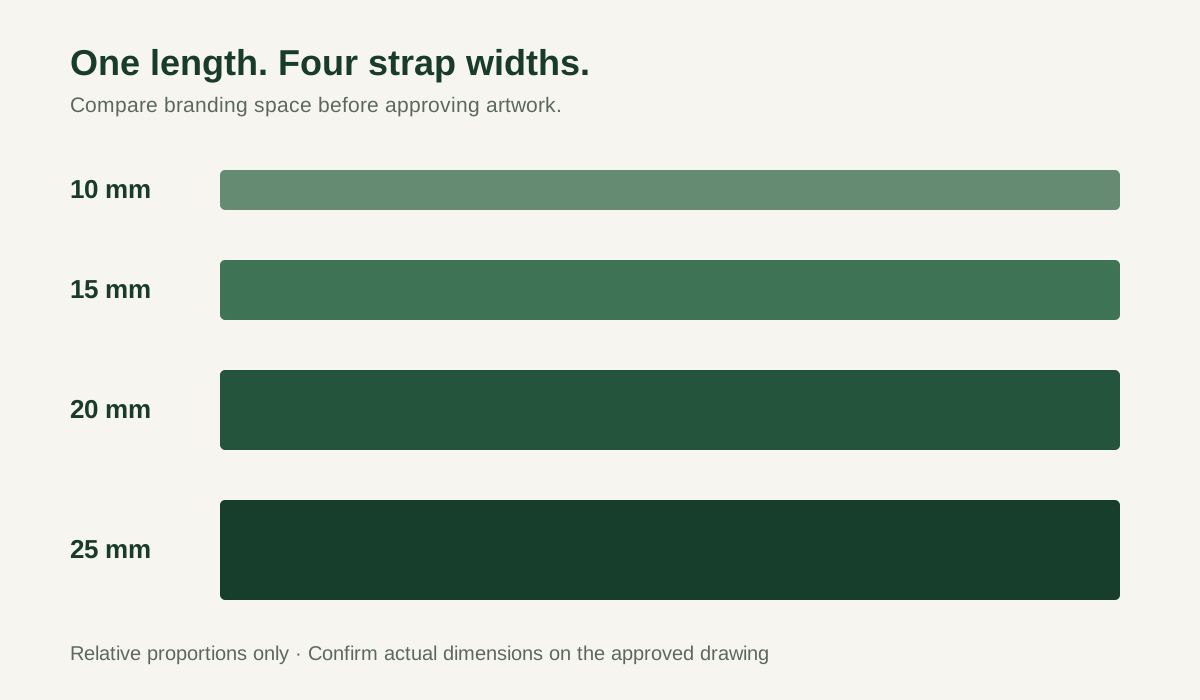
| Comparison | What changes | What to check before approval |
|---|---|---|
| 10 mm vs 20 mm | 20 mm provides twice the nominal strap width, before edge clearances. | A short wordmark may suit 10 mm; test smaller lettering and multi-element logos at 20 mm. |
| 15 mm vs 20 mm | 20 mm gives 5 mm more nominal width, or about 33% more. | Compare the same artwork at actual size, with the same material, length and hook. |
| 20 mm vs 25 mm | 25 mm gives 25% more nominal width. | Check whether the extra artwork area improves readability enough to justify a wider feel. |
What is the difference between a 3/8 inch and 3/4 inch custom lanyard? In common catalog naming, these are roughly the 10 mm and 20 mm options. The wider option offers more branding space. Fractional-inch catalog sizes are nominal equivalents: 3/8 inch is exactly 9.525 mm and 3/4 inch is 19.05 mm. Specify one controlling unit on the purchase order rather than assuming the metric and fractional labels are identical.
How does lanyard width affect logo detail?
Wider webbing lets a logo be printed larger, which can make small letters, gaps and outlines easier to reproduce. It does not automatically fix a low-resolution file or a design with too many tiny details. Judge the smallest text on a 1:1 artwork proof, not a zoomed-in screen preview.
The usable logo height is smaller than the strap width because production needs clearances at the edges. For illustration only, a 15 mm strap with an agreed 2 mm allowance on each edge leaves 11 mm; a 20 mm strap with the same allowance leaves 16 mm. Those allowances are an example, not a universal LANYVO print specification. Ask for the actual safe area for your material and process.
- Supply a vector logo where available, and identify any text that must remain readable.
- Compare the identical design at 15 mm and 20 mm strap widths with the proposed safe area marked.
- Check logo repeat spacing, the seam, front/back direction and the part hidden behind the neck.
- Approve a physical sample when fine detail, color or a repeat-order match is critical.
Choose the logo method together with the width
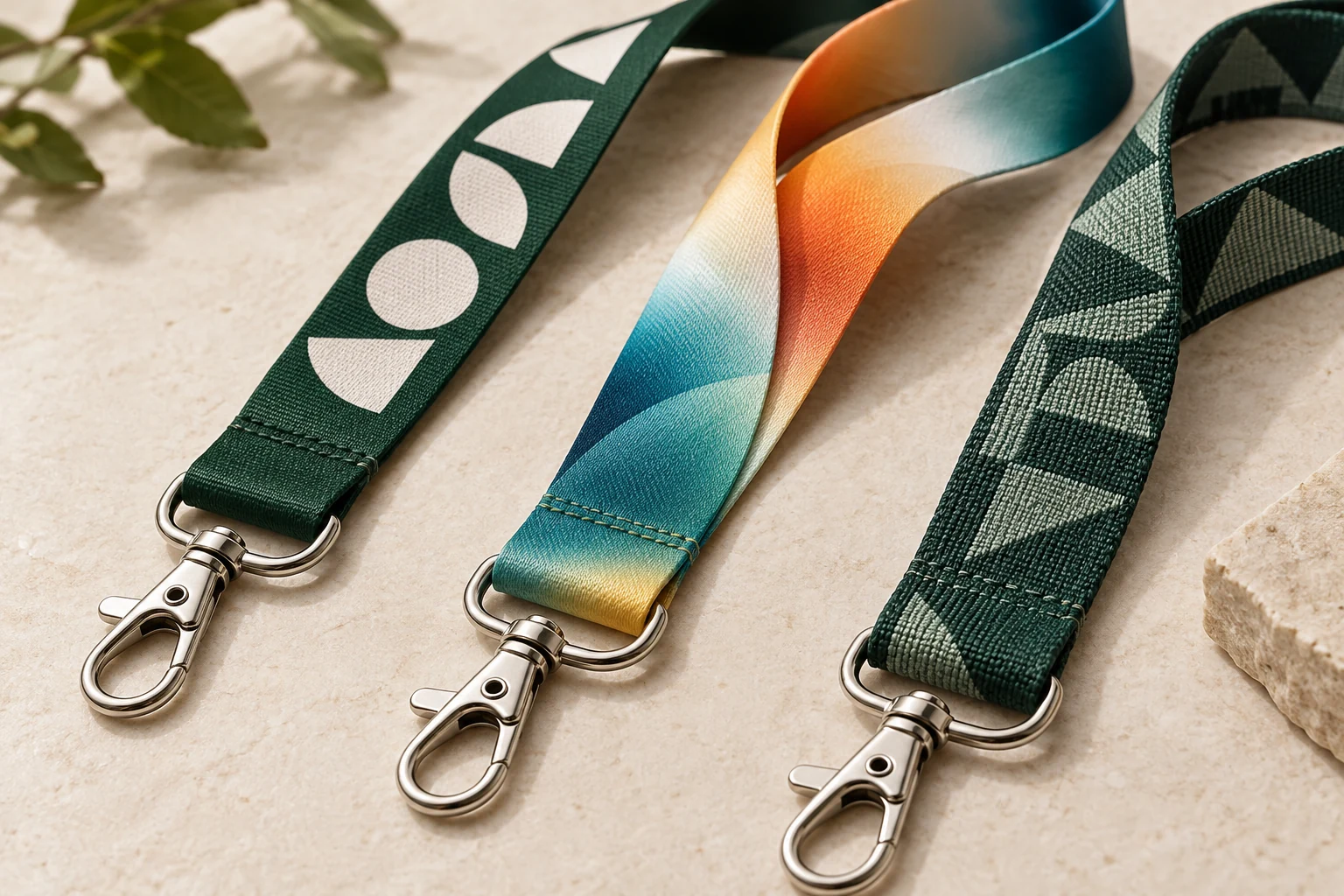
| Logo method | Good starting artwork | Width and proof check |
|---|---|---|
| Custom polyester screen-printed lanyards | Bold logos and limited solid colors | Check thin lines, separated colors and edge clearance. A narrow design may need simpler artwork. |
| Full-color sublimation lanyards | Gradients, multiple colors and repeating graphics | More width can help readability, but full color does not make very small text readable. |
| Woven / jacquard lanyards | Selected solid-color logos with clear shapes | Review the weave-specific minimum detail and reverse side; do not reuse print clearances without checking. |
Suppliers may use “heat transfer” to describe different processes, including sublimation transfer onto polyester. Confirm the material and exact production method rather than treating every transfer label as a separate finish.
What is the most common lanyard width for corporate events?
20 mm is a practical starting point for corporate events with visible sponsor or company branding; 15 mm suits simpler ID artwork. There is no mandatory event width, and we do not have market-wide purchase data to name one universal best seller. Compare these two widths with your actual logo, wearing time and badge weight.
Use 25 mm when the wider design serves a clear branding purpose. For a wide landscape badge, investigate the holder's slot spacing and a two-clip assembly rather than trying to prevent badge rotation by strap width alone. Event-specific planning belongs in the trade show width and attachment guide.
Does lanyard width affect bulk price per unit?
Yes, width can affect material use and production cost, but it does not determine the final unit price by itself. Quantity per design, material, logo method, hardware, packing and freight also matter. A wider strap does not mean the complete kit costs the same percentage more.
At equal strap length, a move from 15 mm to 20 mm increases nominal webbing area by one third. That is geometry, not a price forecast: the hook, badge holder and much of the order setup do not increase by one third. We cannot give a reliable price difference without matched specifications.
Ask for a like-for-like 15 mm vs 20 mm quotation
| RFQ field | Option A | Option B |
|---|---|---|
| Strap width | 15 mm | 20 mm |
| Length | Same agreed total flat length, excluding or including hardware as stated | |
| Quantity | Quote the same quantity per design; optionally compare 500 / 1,000 / 3,000 / 5,000 pcs | |
| Material and artwork | Same material, logo method, colors and sides; resize artwork to each approved safe area | |
| Hardware and kit | Same hook, release, holder dimensions and assembly requirements | |
| Commercial basis | Same packaging, destination, currency and delivery term; itemize setup and freight | |
For a distributor, the useful comparison is the cost per complete, usable kit delivered. A cheaper strap that needs local holder assembly may not be the cheaper finished order. Compare order quantities on the bulk custom lanyard page; use the pricing guide for the full cost breakdown.
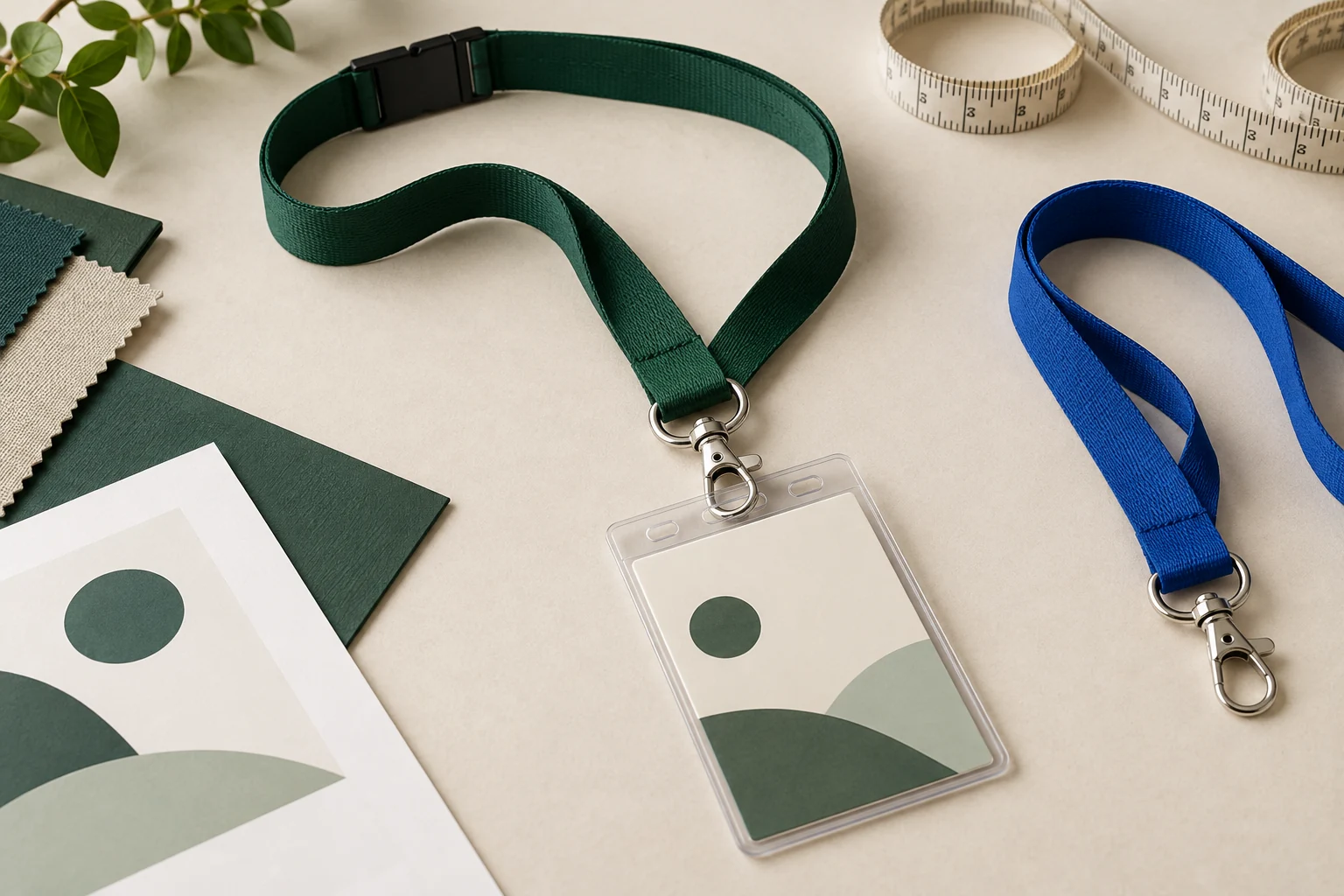
Approve the complete sample—not only the strap
- Check the logo at actual size and confirm the safe area near seams and attachments.
- Install the badge holder or card before checking the final drop.
- Confirm text direction on both sides of the neck.
- Check whether the hook faces forward after assembly.
- Test comfort with the final width, hardware and badge weight.
Use this guide with the commercial product pages
After choosing a width and length, compare production quantities using one matching specification for artwork, hardware and packing.
Frequently asked questions
What is the most common adult lanyard length?
Approximately 900 mm, or 35.4 to 36 inches, is a common adult reference. Some suppliers use 33 to 34 inches as their standard, so the measurement method must be confirmed.
What is the most popular lanyard width?
The 20 mm width is a common balanced choice for trade shows and general branding. Buyers also frequently use 15 mm for lighter ID programs and 25 mm for stronger visual impact.
How should I measure a custom lanyard?
State whether you require total flat length, loop circumference or finished drop. Include the attachment and badge holder in the final wearing-position check.
Is there a standard child lanyard length for schools?
No single child length is suitable for every age, height or institution. The school should define its wearing and release requirements, then approve a fit sample with the actual badge and intended wearer group.
Can I order a custom length?
Yes. Neck and wrist lanyards can be produced in custom lengths, subject to the material, printing method, hardware and order quantity.
Does lanyard width affect bulk price per unit?
Yes. Width can affect material use and production cost, but quantity per design, material, logo method, hardware, packing and freight also affect the final price. Compare matched 15 mm and 20 mm specifications rather than converting the width difference into a price percentage.
What is the most common lanyard width for corporate events?
20 mm is a practical starting point for visible sponsor or company branding, while 15 mm suits simpler ID artwork. There is no mandatory event width; compare the actual logo, wearing time and badge assembly.
How does lanyard width affect logo detail?
Wider webbing allows larger artwork, which can help small letters and outlines remain readable. The usable logo height is smaller than the strap width. Check the agreed safe area on a 1:1 artwork proof and confirm fine detail on a sample.