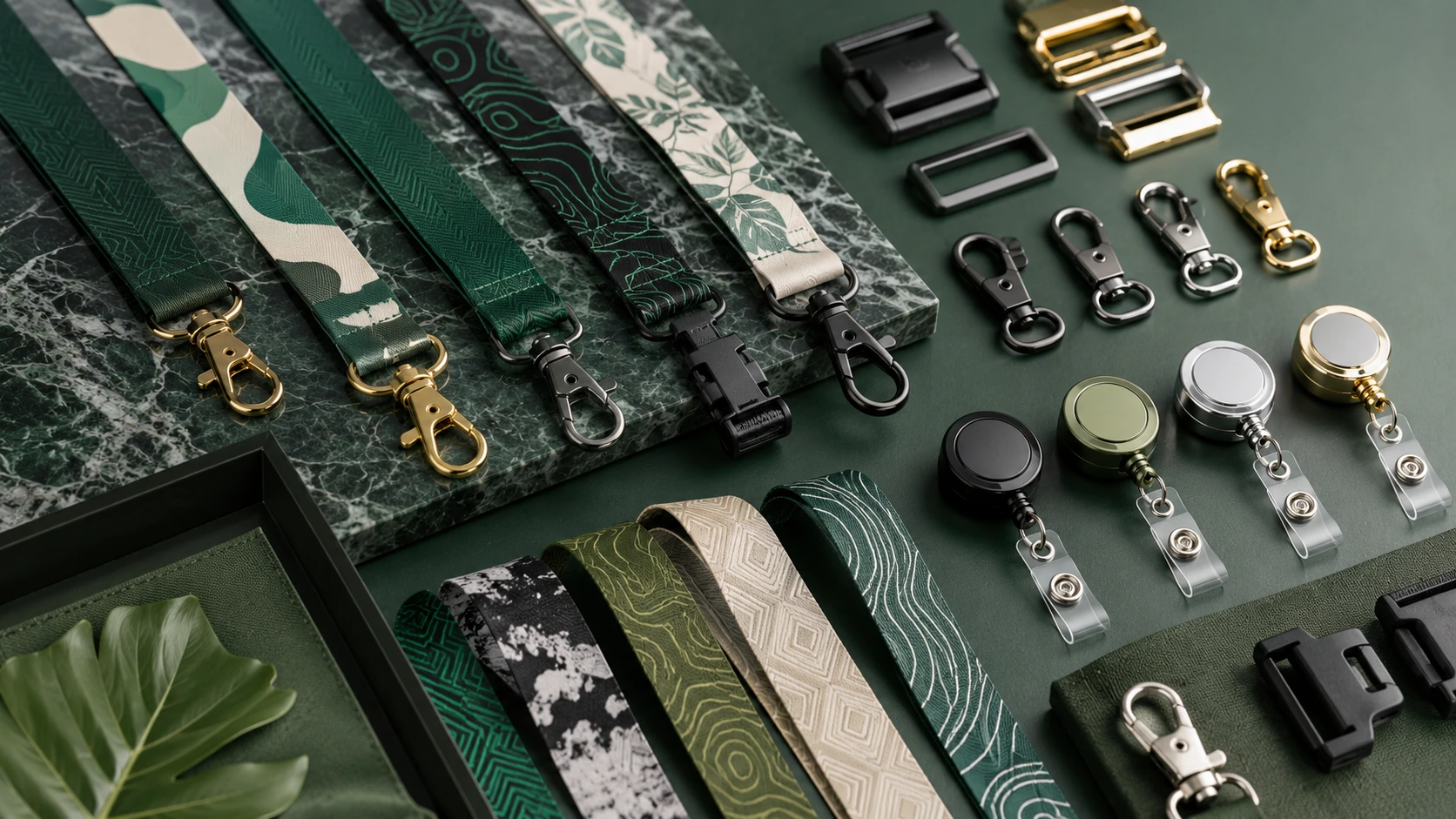
Choose the material and branding method together. Standard polyester is the most versatile option, RPET supports recycled-material programs, nylon gives a smoother premium surface, tubular polyester is light and economical, sublimation suits full-color artwork, screen printing suits simple solid-color logos, and woven or jacquard branding suits durable simple designs.
Compare common lanyard materials
| Material | Look and feel | Best for | Main buyer check |
|---|---|---|---|
| Flat polyester | Durable, matte to semi-smooth, widely available | Events, schools, staff IDs and promotional programs | Confirm weave density, edge feel and print sharpness |
| RPET polyester | Similar to polyester, made with recycled-PET content | Sustainability programs, trade shows and corporate campaigns | Confirm the material claim and any required supporting documentation |
| Nylon | Smoother, shinier and more premium-looking | VIP, executive, conference and premium brand programs | Check surface gloss, color, logo adhesion and cost |
| Tubular polyester | Soft, cord-like and lightweight | Budget ID programs, schools and simple one-color logos | Limited print area; complex artwork is not suitable |
| Satin / fine polyester | Soft, smooth and fashion-oriented | Retail, beauty, gift and merchandise projects | Check color consistency, seam finish and snag resistance |
| Cotton or bamboo blend | Natural hand feel and softer visual style | Selected eco, lifestyle and gift programs | Material availability, color matching and MOQ may differ |
Compare logo and printing methods
| Method | Best artwork | Main strengths | Limitations / MOQ |
|---|---|---|---|
| Screen printing / silk screen | Simple text and solid-color logos | Clean, economical and practical for bulk orders | MOQ 500 pcs; artwork and setup affect pricing; not ideal for gradients or photos |
| Heat transfer / dye sublimation | Full-color logos, gradients, photos and edge-to-edge patterns | High artwork detail and strong color flexibility | MOQ 500 pcs; final pricing follows specification review; color should be checked on a sample |
| Woven / jacquard logo | Simple logos, text and geometric designs | Branding is woven into the strap and does not peel like surface print | Fine details and gradients are limited; reverse side differs from front |
| Offset / multi-color surface print | Detailed repeated graphics on suitable webbing | Alternative for selected complex printed projects | Suitability depends on material and artwork; confirm by sample |
How material and printing should be paired
Simple corporate logo
Use flat polyester with screen printing for clean solid-color logos when the artwork and project specification suit this process.
Full-color event artwork
Use smooth polyester or RPET with dye sublimation for gradients, sponsor logos and multi-color patterns.
Durable premium identity
Use woven or jacquard branding when the logo is simple and the tactile, long-lasting appearance matters.
Eco-positioned campaign
Use RPET with a print method that matches the artwork, then confirm the exact recycled-material claim before publication.
Hardware also changes the finished product
A material and print combination can still fail if the attachment does not suit the use. Compare J hooks, lobster claws, swivel hooks, bulldog clips, split rings, breakaway releases, detachable buckles, badge reels and double-ended clips according to the card, keys, phone or access-control device being carried.
What to check on the pre-production sample
- Material hand feel, weave density, thickness and edge finish.
- Artwork size, text readability, color and repeated-logo spacing.
- Front and reverse appearance, especially for woven designs.
- Print adhesion, rub resistance and seam position.
- Hook orientation, buckle operation and breakaway release.
- Badge holder fit and the final wearing position.
Practical selection rules
- Use screen printing for simple solid-color artwork when the project setup supports it.
- Use sublimation for detailed full-color artwork, gradients and edge-to-edge color.
- Use woven branding for simple durable logos with a premium textile look.
- Use RPET when recycled-content positioning is important and can be documented accurately.
- Approve material, print and hardware together on the same sample.
Frequently asked questions
What is the best material for a custom event lanyard?
Flat polyester is the most versatile starting point. RPET is suitable for recycled-material programs, while nylon or satin can suit a more premium appearance.
What is the difference between screen printing and sublimation?
Screen printing applies solid-color ink to the surface and is best for simple logos. Sublimation transfers full-color artwork into suitable polyester material and supports gradients and detailed graphics.
What is the MOQ for screen-printed lanyards?
Screen-printed lanyards have a custom-production MOQ of 500 pcs. Strap, artwork, color count, hardware, packaging and quantity affect the final quotation.
Do woven lanyards support gradients and photographs?
No. Woven and jacquard branding is best for simplified logos, text and geometric artwork. Full-color sublimation is more suitable for gradients and photographs.